Agentic Match Forecasting
A forecasting prototype connecting probability models, MCP tools, and a reviewable agent workflow.
Problem
A forecast interface needs consistent probabilities, visible uncertainty, and traceable inputs. An agent also needs clear boundaries between generating an analysis and acting on a recommendation.
Approach
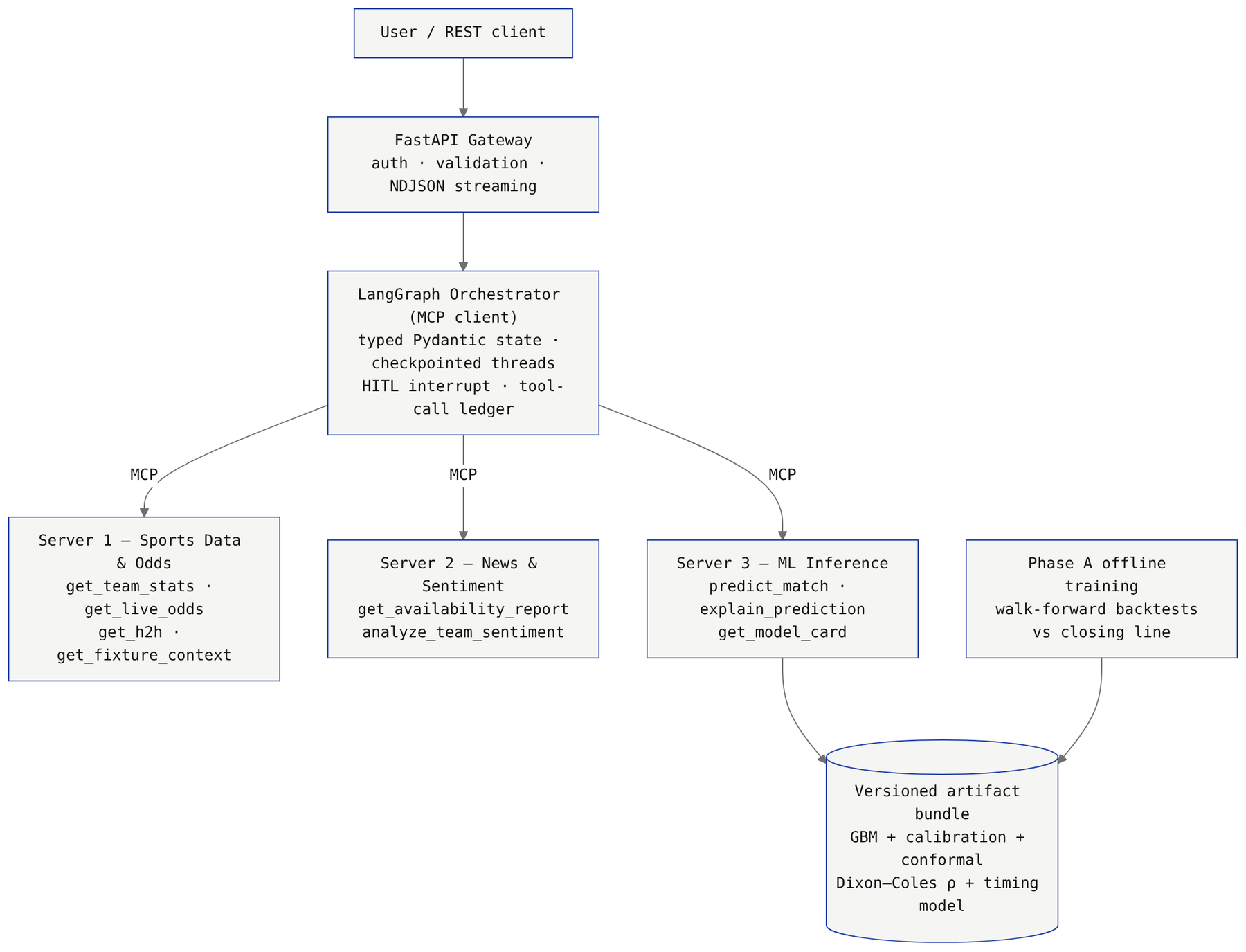
Combined XGBoost, calibration, and prediction sets with a Dixon-Coles score grid. A FastAPI gateway connects a LangGraph orchestrator to three MCP servers; a separate simulator evaluates staking policies and reward behavior.
What I built
Built the modeling pipeline, MCP orchestration, approval flow, deterministic agent evaluations, and NumPy GRPO experiments. Separated application demo artifacts from historical forecast reports.
Result
The historical World Cup report records 0.9013 log loss and 62.7% accuracy on 102 matches with pre-tournament training. The served artifact and upstream tool backends are demos. Historical calibration splits still need stronger isolation.
One probability grid, traceable tool calls
Derived match markets share a score-grid representation. The agent response exposes its supporting calls so a reviewer can follow where an output came from. The repository documents the artifact bundle and orchestration boundaries.
Evaluate failure before claiming an edge
The project includes a deterministic agent suite and policy stress tests. Closing-market baselines remain stronger in the reported Premier League aggregate. These experiments do not establish live profitability or general prompt-injection resistance.