3D perception / ML systems
Synthetic orchard depth served through FastAPI and split ONNX graphs, with parity and GPU latency checks.
Synthetic-only evaluation. Recorded Torch/ONNX encoder max difference: 1.53e-5; V100 fp16 p50: 156 ms.
Jose Sanchez Gonzalez · M.S. Artificial Intelligence
Seeking machine learning / AI and robotics engineering roles.
Explore depth inference, learned robot control, vision-guided pruning, and retrieval software. Four case studies connect working demos to source code and measured results.
Selected work
Start with a demo. Follow the case study to the code, evaluation, and tradeoffs.
3D perception / ML systems
Synthetic orchard depth served through FastAPI and split ONNX graphs, with parity and GPU latency checks.
Synthetic-only evaluation. Recorded Torch/ONNX encoder max difference: 1.53e-5; V100 fp16 p50: 156 ms.
Robotics / Simulation / Perception
UR5e live RGB-D approach, gated spur release, and home return in a two-tree Blender orchard.
One known target, 68 vision commands, 17/17 sequence checks. Rigid-piece release, not wood fracture.
Robot learning / Simulation evaluation
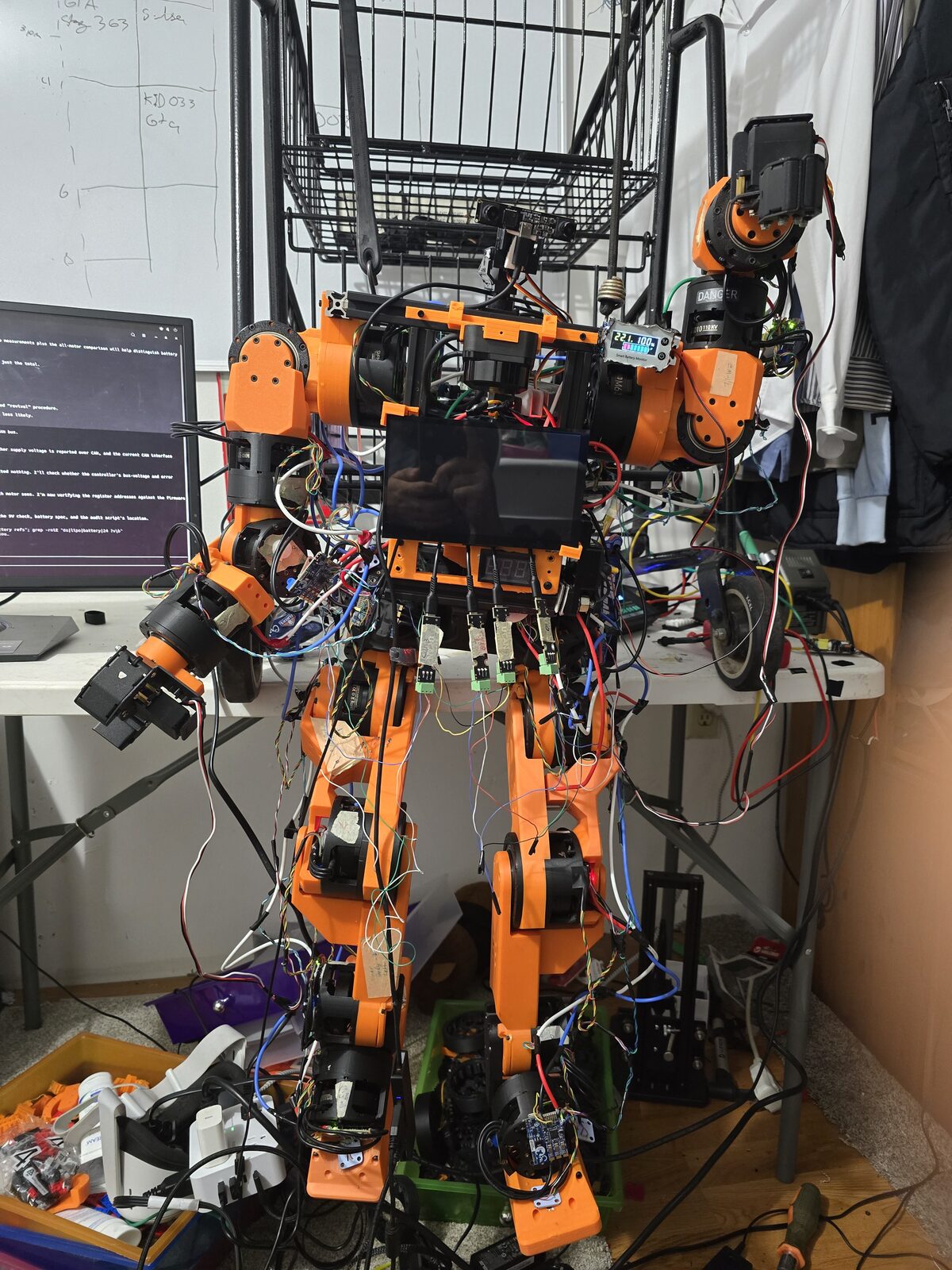
Humanoid learning and evaluation across Isaac Lab and MuJoCo, with sensor ablations and shared-world team tasks.
Isaac: 379/384 first episodes. Separate frozen-gait MuJoCo: inspection 3/3; two- and three-robot teams 5/5 each.
RAG / Retrieval engineering
Find the current configuration, trace the supporting files, and review proposed changes before applying them.
Recall@50 0.938 on 136 labeled queries over a frozen 61-file fixture corpus.
Further work
Focused experiments and coursework, with their current limits stated alongside the results.
Manipulation / Research in progress
A folding-policy port and camera-health investigation. Strict evaluation has not shown an adaptation gain.
Strict short-pants scores: baseline 8/24 vs adapted 3/24. No measured gain; 5/12 full evaluation cells complete.
Agent systems / Applied ML
A forecasting prototype connecting probability models, MCP tools, and a reviewable agent workflow.
Historical World Cup report: 62.7% accuracy across 102 matches; served application uses demo data.
NLP / Constrained decoding
A PyTorch transformer that generates structured math programs, with correct and incorrect decodes to inspect.
77.45% exact graph match and 84.78% 2-gram BLEU on the MathQA test set.
3D perception / Deep learning
Compare point-based classifiers through predicted labels, local attention, and concrete failure cases.
86.79% on 2,468 ModelNet10 test clouds, from the train_pointtransformer.ipynb output cell.
Background
I turn research questions into working software: vision-guided pruning in Isaac Sim, depth models for orchard robots, cross-simulator policy evaluations, and retrieval tools that trace answers to source files. M.S. in Artificial Intelligence and B.S. in Computer Science, Oregon State University. My project pages show what I built, how I tested it, and what still needs work.
At Oregon State, I led operating systems and computational methods studios and tutored more than 50 students in mathematics and computer science.
MS, Artificial Intelligence
Oregon State University · Jun 2026
BS, Computer Science (Applied — Data Science), Math minor
Oregon State University · Jun 2025
Python, C++, PyTorch, FastAPI, Docker, PostgreSQL, Isaac Sim, MuJoCo, and Slurm.
Let's talk
I’m looking for a team building robot perception, simulation, or ML systems. My work pairs working demos with reproducible evaluations.
josejsanchez20172@gmail.com